Latvian Americans: Who They Are and Where They Live

In early July 2026, downtown Grand Rapids, Michigan, belonged to Latvians. The 16th Latvian Song and Dance Festival brought 3,000 to 4,000 participants and guests from the United States, Canada, Latvia, Brazil, Switzerland and beyond, with more than 400 choir singers and nearly 800 folk dancers performing at DeVos Performance Hall and Van Andel Arena.
The festival is the most visible sign of a community that has kept its language and its music for three generations after exile. About 85,000 people in the United States report Latvian ancestry, roughly three times as many as report Estonian roots. Most descend from the refugees who came after the Second World War. This guide sets out who Latvian Americans are, where they live and how they came, using the latest Census Bureau figures.
How many Latvian Americans there are
In the Census Bureau's American Community Survey for 2020 to 2024, 85,406 people reported Latvian ancestry, as a first or second answer to the question about their origins.
The figure has stayed close to that level for a quarter of a century. The 2000 census counted 87,564 people of Latvian ancestry, and the survey's estimate for 2006 to 2010 was 91,096. In the single-year survey for 2019 the count was 85,723.
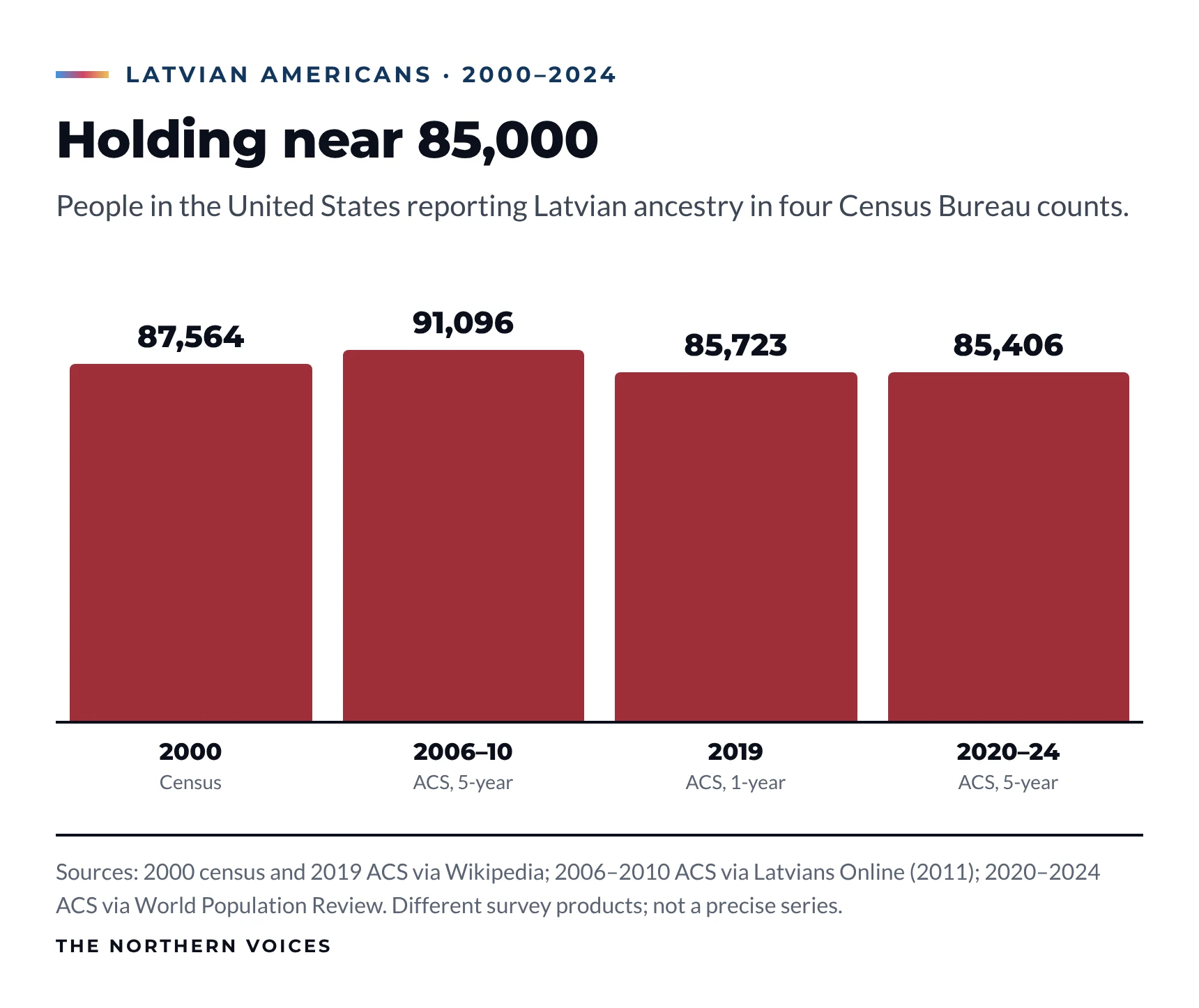
These counts measure ancestry as people describe it, not birthplace or citizenship. They include descendants who may speak no Latvian and leave out some people born in Latvia who give another answer. The four counts in the chart come from different survey products and carry margins of error, so they show a community holding its size rather than a precise trend.
The Latvian community is also small beside its southern neighbor's. Lithuanian Americans outnumber Latvian Americans by about eight to one, according to an American Latvian Association report on survey data for 2010 to 2014, as reported by the Latvian public broadcaster LSM.
Where they live
California has the most people of Latvian ancestry, 10,021, followed by New York with 7,707, Florida with 5,185 and Illinois with 4,536. New Jersey, Massachusetts, Washington, Michigan, Pennsylvania and Texas complete the top ten.

The same American Latvian Association report counted about 9,031 people of Latvian ancestry in the New York metropolitan area, 4,926 around Chicago and 3,660 around Los Angeles. Those are older figures, but they show the pattern the postwar refugees set: large cities first, with clusters in the Midwest and on the West Coast.
How they came
The first sizable group of Latvian immigrants arrived in Boston in 1888. Most later moved on to cities such as New York, Philadelphia, Cleveland, Chicago, Seattle and Los Angeles.
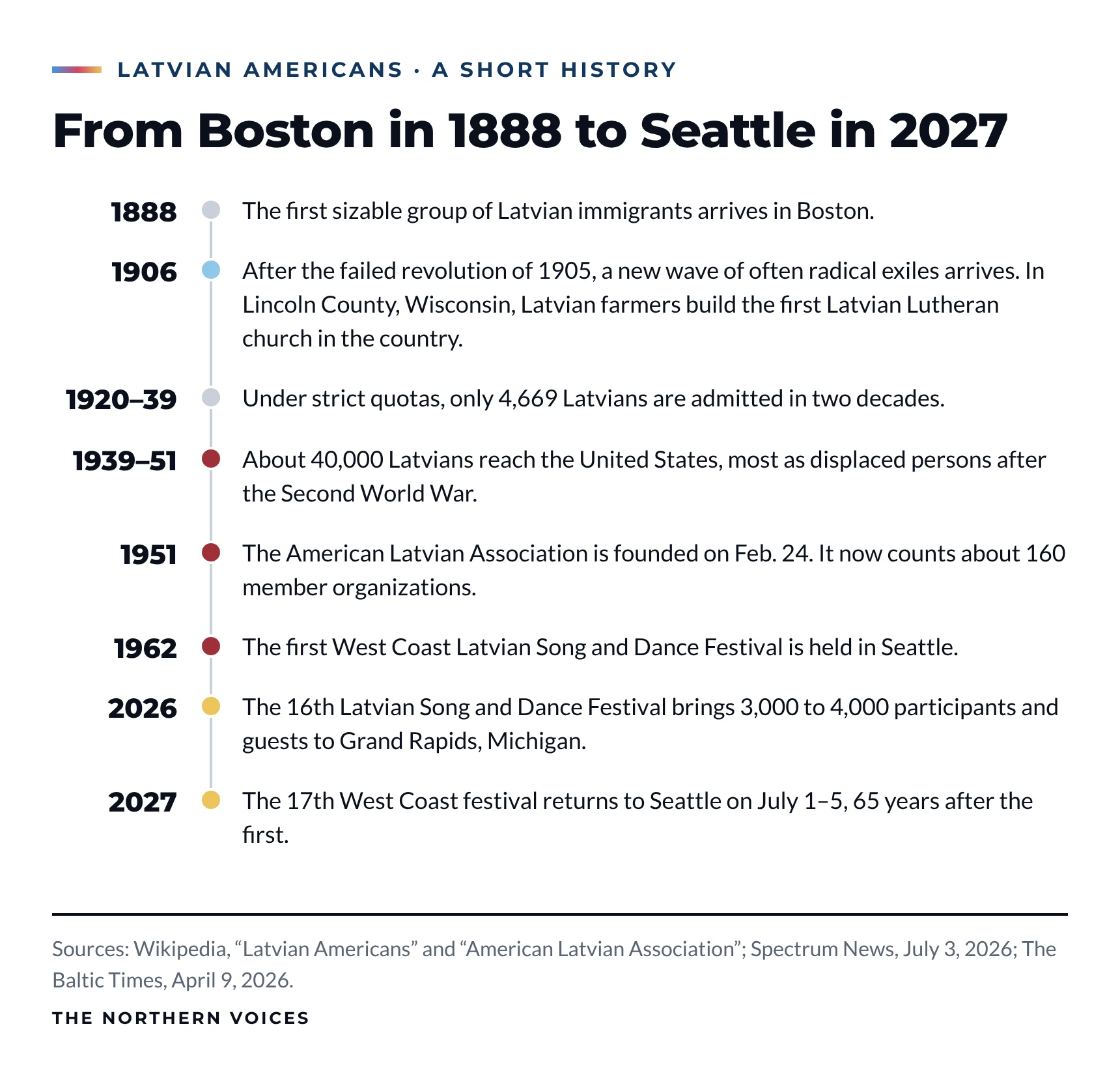
A second wave began around 1906, after the failure of the 1905 revolution in the Russian Empire. Many of these newcomers were political radicals, and some went back in 1917 and 1918. Others farmed. In Lincoln County, Wisconsin, where Latvians had founded an agricultural colony in 1897, they built the first Latvian Lutheran church in the United States in 1906.
Between the world wars, strict American immigration quotas allowed only 4,669 Latvians to enter in two decades. The Second World War changed the scale. As the Soviet army returned in 1944, tens of thousands of Latvians fled west, and about 40,000 reached the United States between 1939 and 1951, most as displaced persons with the help of the government and charities. Many had been professionals in Latvia and began American life as farmhands, custodians and construction workers.
The institutions they built
The refugees quickly built a dense web of their own institutions: schools, credit unions, choirs, dance groups, theater troupes, publishers and churches, along with veterans' groups such as Daugavas Vanagi. Most Latvian Americans are Lutheran, but there are also Catholic, Baptist and Jewish communities.
To speak with one voice, 79 representatives of Latvian centers met on April 15, 1950, and the American Latvian Association was founded on Feb. 24, 1951, at a congress of 115 delegates representing 11,260 members. Today it is based in Rockville, Maryland, and counts about 160 member organizations and about 6,000 individual members. It supplies books to Latvian schools, organizes educational trips to Latvia and helps new arrivals. In 1961 it joined the Estonian American National Council and the Lithuanian American Council to form the Joint Baltic American National Committee in Washington.

A community that sings
Music is where the community is most visible. Latvian Americans stage their own song and dance festivals, and the national festival in Grand Rapids in July 2026 was the 16th. On the Pacific coast, the West Coast Latvian Song and Dance Festival has moved among cities since the first one was held in Seattle in 1962. Its 17th edition returns to Seattle on July 1–5, 2027, as we reported in our festival guide.
Notable Latvian Americans
The painter Mark Rothko was born in 1903 in Daugavpils, then in the Russian Empire, and came to the United States as a child. Jacob Davis, born Jēkabs Jufess in Rīga, patented riveted denim work pants with Levi Strauss in 1873. The computer scientist Juris Hartmanis won the Turing Award in 1993. Gunnar Birkerts designed buildings across the Midwest and the National Library of Latvia in Rīga, and Juris Upatnieks was a co-inventor of practical holography.
The tie to Latvia today
Many Latvian Americans hold Latvian citizenship and vote in Latvian elections. At the Saeima election in October 2026, voters in the United States and Canada cast their ballots at polling stations and by post. Our analysis shows how North America voted.
Sources and method
Population and states: U.S. Census Bureau, American Community Survey 2020–2024 five-year estimates, table B04006 (people reporting ancestry), as compiled by World Population Review. The 2000 census and 2019 survey figures, history and religious communities: Wikipedia, Latvian Americans. The 2006–2010 survey figure: Latvians Online, Dec. 8, 2011. Metropolitan areas and the comparison with Lithuanian Americans: LSM, Feb. 24, 2017, citing an American Latvian Association report. American Latvian Association: Wikipedia, American Latvian Association. Grand Rapids festival: Spectrum News, July 3, 2026. West Coast festival: The Baltic Times, April 9, 2026.
Ancestry counts are survey estimates and include people who name Latvian as a second ancestry. State figures carry margins of error, and the national counts from different survey years are not a strict series.
Lead photograph: dancers in folk costume at the Latvian Song and Dance Celebration in Rīga in 2023, by Diaaaana, CC BY-SA 4.0, via Wikimedia Commons.

)%20(1).avif)